

Jawaharlal Nehru Medical College (JNMC)
Jawaharlal Nehru Medical College (JNMC) is a public medical school and teaching hospital in Aligarh, Uttar Pradesh, India. Established in 1962, it is part of Aligarh Muslim University and is known for its contributions to medical education, research, and healthcare in North India. Key facts Founded: 1962 Affiliation: Aligarh Muslim University Location: Aligarh, Uttar Pradesh, India Courses: MBBS, MD/MS, DM/MCh, PhD Teaching hospital: JNMC Hospital with ~1,500 beds History and establishment The college was founded during the tenure of AMU Vice-Chancellor Col. Bashir Husain Zaidi and named after India’s first Prime Minister, Jawaharlal Nehru. It began with a modest setup that has grown into one of India’s prominent government-run medical institutions. Its establishment aimed to improve healthcare access and medical education in the region. Academics and training JNMC offers undergraduate (MBBS) and postgraduate (MD/MS) programs, along with super-specialty and doctoral degrees. It admits students through the National Eligibility cum Entrance Test. Training integrates classroom instruction with extensive clinical exposure at its attached teaching hospital, emphasizing both patient care and community health. Research and facilities The institution conducts research across disciplines including infectious diseases, public health, and molecular biology. It houses specialized centers for cardiology, neurology, and oncology, and participates in national health initiatives and collaborative studies funded by agencies such as the Indian Council of Medical Research. Campus and hospital Located on the AMU campus, JNMC’s facilities include modern lecture halls, laboratories, hostels, and the expansive JNMC Hospital. The hospital serves as a tertiary care center for western Uttar Pradesh, providing low-cost treatment and training opportunities for students. Recognition and impact JNMC is consistently ranked among top medical colleges in India by national surveys. Its alumni serve in prominent medical, academic, and administrative roles globally, reinforcing the college’s reputation as a leading institution for medical education and service.
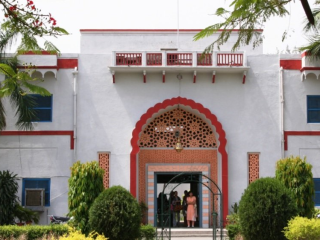
AMU Women’s College
AMU Women’s College is a constituent institution of Aligarh Muslim University in Aligarh, Uttar Pradesh, India. It provides higher education exclusively to women, emphasizing academic excellence, social awareness, and empowerment within the framework of the university’s historic commitment to modern education for Muslims in India. Key facts Founded: 1906 (as Girls’ School); became Women’s College in 1920 Affiliation: Aligarh Muslim University Location: Aligarh, Uttar Pradesh, India Principal: Prof. Naima Khatoon (as of 2023) Programs: Undergraduate and postgraduate degrees in arts, sciences, and social sciences Historical background The college traces its roots to the establishment of a girls’ school by Sheikh Abdullah, a noted social reformer and educationist, and his wife Waheed Jahan Begum. It evolved into a degree college in 1920 when Aligarh Muslim University was founded. The institution was conceived to advance Muslim women’s education during a time when female literacy in India was low. Academic and campus life AMU Women’s College offers programs in humanities, social sciences, natural sciences, and professional disciplines. The campus includes hostels, libraries, and cultural societies designed to foster intellectual and personal growth. It remains one of the few women’s colleges integrated within a major coeducational university in India, giving students access to AMU’s wider academic and research resources. Significance and impact The college has played a pivotal role in promoting women’s higher education in northern India and among Muslim communities. Its alumni have contributed to academia, civil services, law, and social reform. The institution continues to symbolize the progressive educational vision of its founders while adapting to contemporary academic standards and global educational trends.
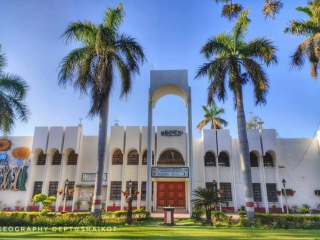
Aligarh Muslim University
Aligarh Muslim University (AMU) is a central public university located in Aligarh, Uttar Pradesh, India. Established in 1920, it evolved from the earlier Muhammadan Anglo-Oriental College founded by Sir Syed Ahmad Khan in 1875. AMU has long been a leading center for higher learning in India, emphasizing modern education among the Muslim community and promoting inclusive academic excellence. Key facts Founded: 1920 Founder: Sir Syed Ahmad Khan Location: Aligarh, Uttar Pradesh, India Type: Central University Motto: “Taught man what he knew not” Historical background The university originated as the Muhammadan Anglo-Oriental College, modeled after British universities such as University of Cambridge. Its transformation into Aligarh Muslim University in 1920 marked the institutional culmination of the Aligarh Movement—a reformist effort to integrate modern Western education with Islamic values. The campus architecture and academic model continue to reflect this synthesis. Academic structure and programs AMU offers more than 300 programs through faculties of sciences, social sciences, engineering, law, medicine, and theology. It also operates several off-campus centers across India. The university’s schools, including Zakir Husain College of Engineering and Technology and Jawaharlal Nehru Medical College, Aligarh, are well recognized for professional education and research. Cultural and intellectual significance The institution has been a crucible for political, literary, and scientific thought in South Asia. Its alumni include national leaders, jurists, scientists, and artists who contributed significantly to India’s independence and postcolonial development. AMU remains emblematic of educational reform and secularism within India’s pluralistic society. Campus and legacy Spread over more than 450 hectares, the AMU campus features distinctive Indo-Islamic architecture, centered around the iconic Bab-e-Syed Gate and Maulana Azad Library. The university’s traditions—such as its residential system, student unions, and literary societies—continue to uphold the reformist vision of its founder.
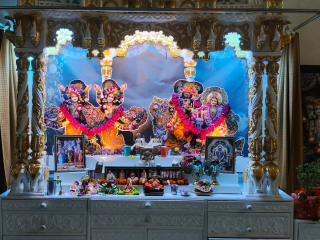
ISKCON Temple
The ISKCON Temple Aligarh is a spiritual and cultural landmark of the International Society for Krishna Consciousness (ISKCON), located in Aligarh, Uttar Pradesh, India. Dedicated to Lord Krishna, the temple serves as a hub for Vaishnava worship, devotional music, and community service in the region. Key facts Deity: Radha Krishna Affiliation: International Society for Krishna Consciousness (ISKCON) Location: Rasal Ganj, Aligarh, Uttar Pradesh, India Established: Early 2000s (approximate) Primary festival: Janmashtami Architecture and Layout The temple showcases traditional North Indian temple architecture with domed shikharas and intricately carved motifs. The main sanctum houses the deities of Sri Sri Radha and Krishna, surrounded by bright murals depicting scenes from the Bhagavad Gita and the life of Krishna. The temple complex includes prayer halls, guest facilities, and a prasad distribution area. Religious and Cultural Activities ISKCON Aligarh conducts regular bhakti-yoga sessions, kirtans (devotional singing), and classes on the Bhagavad Gita. Major festivals such as Janmashtami and Ratha Yatra draw large crowds, featuring devotional processions and cultural programs. The temple also organizes youth outreach and food donation drives under the “Food for Life” initiative. Community Role Beyond worship, the temple acts as a community center promoting spiritual education and social welfare. It attracts devotees, students, and visitors seeking a serene environment for meditation and cultural engagement. The temple’s charitable work, particularly in providing meals to the needy, has made it an integral part of Aligarh’s social landscape.
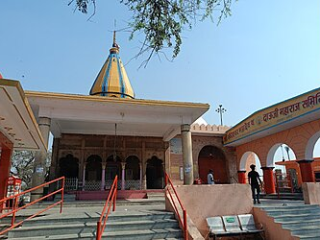
Shiv Mandir
Shiv Mandir on GT Road in Aligarh, Uttar Pradesh, India, is a prominent Hindu temple dedicated to Lord Shiva. Situated along the city’s main thoroughfare, it serves as both a spiritual landmark and a cultural gathering place for devotees and travelers. Key facts Deity: Lord Shiva Location: GT Road, Aligarh, Uttar Pradesh, India Religious tradition: Hinduism, Shaivism Notable events: Maha Shivratri celebrations Accessibility: Located near major city routes and public transport History and Significance The temple has long been a focal point of Shaivite worship in Aligarh. While its exact date of establishment is not clearly documented, the site reflects the traditional North Indian temple style common to roadside shrines along the historic Grand Trunk Road. Over the years, it has evolved into a community hub where locals and pilgrims gather for regular prayers and annual festivals. Architecture and Features Shiv Mandir features a modest yet classic design with a spire (shikhara) above the sanctum housing the Shiva lingam. The temple’s interior is adorned with depictions of Lord Shiva, Goddess Parvati, and other deities. Its open courtyard accommodates large gatherings, particularly during religious observances. Cultural Role and Festivals The temple is especially vibrant during Maha Shivratri, when devotees perform night-long prayers and rituals. Other auspicious occasions like Shravan month and Mondays see heightened activity. The temple’s location on GT Road allows it to serve both local worshippers and those journeying through Aligarh, reinforcing its role as a spiritual waypoint on one of India’s oldest highways.
Panethi Temple
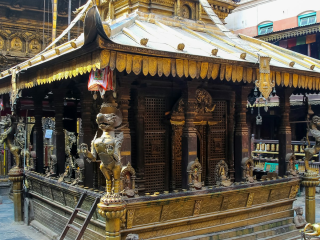
Panethi Temple is a small local Hindu shrine associated with the village of Panethi in Dhanipur block of Aligarh district, within Uttar Pradesh, India. It serves primarily as a neighborhood place of worship rather than a major regional pilgrimage site, and information about it is mostly local and informal. Because detailed, official documentation is scarce, most references place it simply among the cluster of temples serving Panethi and nearby villages. Type: Local Hindu temple (village shrine) Location: Panethi village, Dhanipur block, Aligarh district, Uttar Pradesh Primary role: Daily worship for nearby residents Tourism profile: Very low; mainly local devotees Setting: Rural / semi-rural agrarian landscape Location and setting Panethi is a village located a short distance east of the city of Aligarh, in an agrarian belt of western Uttar Pradesh. Temples here are typically modest structures integrated into village streets or located near fields, ponds, or banyan/peepal trees that also function as community gathering points. Panethi Temple fits into this pattern as a neighborhood shrine rather than a standalone destination complex. Religious role and activities As a village temple, its core function is to host daily worship, simple ārtī, and small-scale observances of major Hindu festivals such as Navratri, Diwali, and Shivratri or Krishna-related festivals, depending on the presiding deity. Such temples usually rely on local donations, with rituals performed either by a resident priest or by villagers themselves on important days. Visitor experience and access Visitors to Panethi Temple can expect a very informal, community-centered atmosphere: minimal crowds, basic facilities, and close interaction with local residents. Reaching it typically involves traveling first to Aligarh city and then continuing by local road towards Panethi village via Dhanipur; there is no indication of dedicated tourist infrastructure, so visitors generally coordinate locally for directions and timing.
Shri Khereshwar Temple
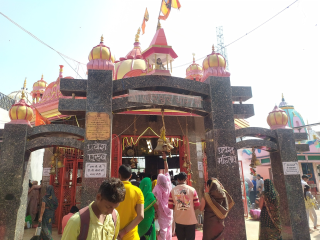
Khereshwar Temple is a revered Hindu shrine located near Aligarh, Uttar Pradesh, India. Dedicated to Lord Shiva, it is locally known as the Khereshwar Mahadev Temple and is a significant site for devotees, particularly during the holy month of Shravan. Key facts Deity: Lord Shiva (Mahadev) Location: Near Aligarh city, Uttar Pradesh, India Religious significance: Major pilgrimage site during Shravan Architectural style: Traditional North Indian temple design Religious significance The temple holds deep spiritual importance for followers of Lord Shiva. Pilgrims visit throughout the year, with peak attendance during Shravan and on Maha Shivaratri. Local tradition considers the temple a powerful place for blessings and fulfillment of vows, contributing to its prominence in regional devotion. Architecture and surroundings The temple features classic North Indian architecture, with a prominent shikhara (spire) and sanctum housing a Shiva linga. The site is set amid a serene landscape, enhancing its atmosphere of devotion and tranquility. Surrounding areas often host fairs and gatherings during religious festivals, drawing both locals and visitors. Cultural and local role Khereshwar Temple serves as a focal point for community worship and local cultural events. Its presence reinforces Aligarh’s spiritual heritage, connecting contemporary worship practices with long-standing Shaivite traditions of the region.

🛕 Achal Taal Temple
Achal Taal Temple is a historic lakeside temple complex in Aligarh, Uttar Pradesh, centered around the Achal Sarovar (Achal Taal) and the prominent Hanuman shrine often called Gilahraj Ji Hanuman Mandir. It is both a local pilgrimage site and a symbolic heritage landmark linked in legend to the Mahabharata period. One of the oldest and most sacred temples in Aligarh Located near Achal Taal Lake Dedicated to Lord Shiva A major center during Mahashivratri Known for peaceful surroundings and spiritual importance